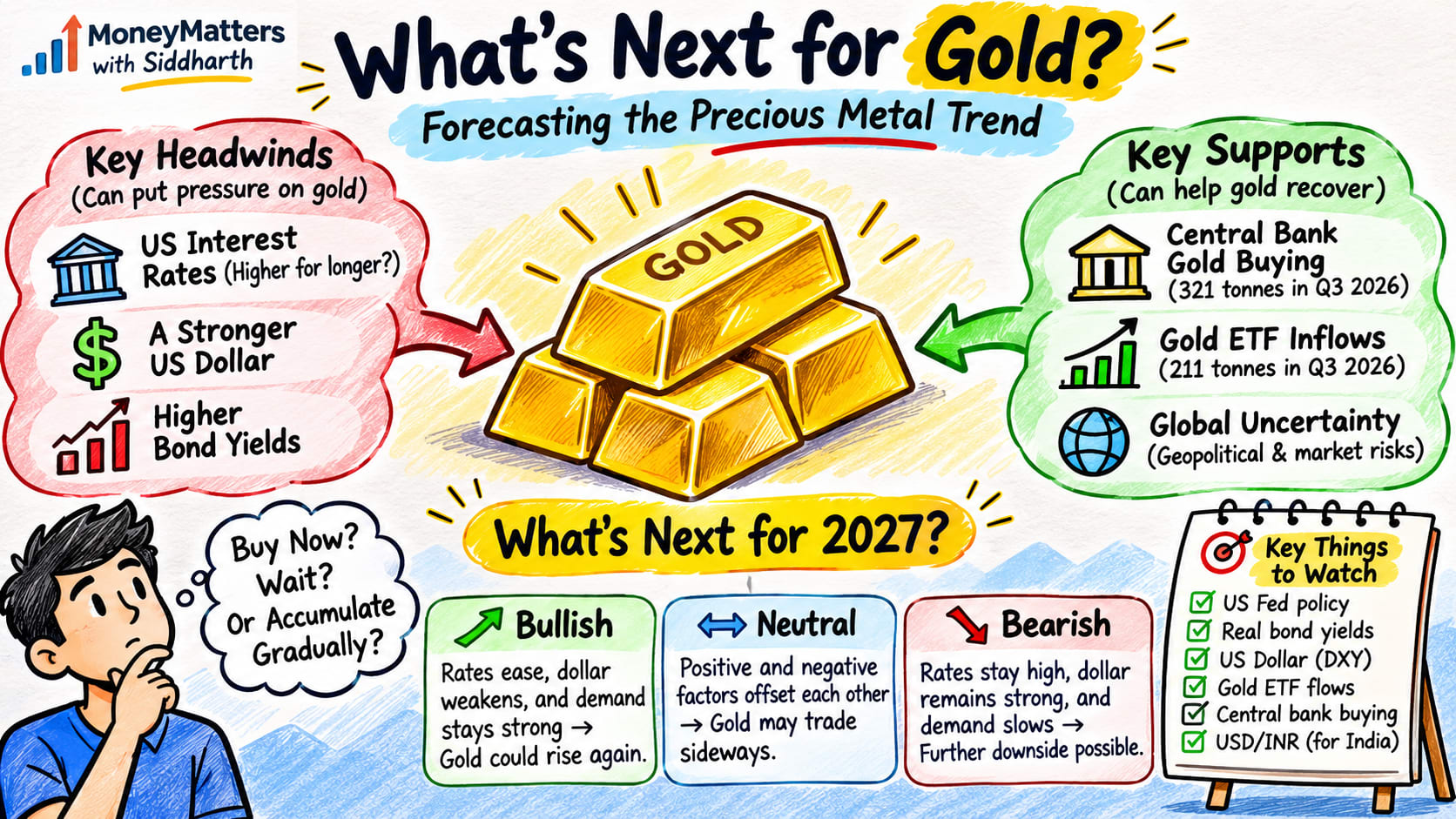
Gold has always held a special place in Indian households. From wedding jewellery and traditional savings to modern gold ETFs, the precious metal is widely regarded as a store of value.
But recently, gold has reminded investors of an important reality: even a traditional safe-haven asset can experience sharp price corrections.
After an exceptionally volatile 2026, investors are asking a familiar question:
What's next for gold? Will gold prices rise again in 2027, or is the precious metal entering a prolonged correction?
The answer depends on several interconnected factors, including US interest rates, central bank purchases, inflation, geopolitical tensions and the strength of the US dollar.
Let's examine the latest developments and what they could mean for gold investors in India.
1. Gold Market Update: What's Happening in November 2026?
Gold experienced significant selling pressure during November 2026 as financial markets adjusted to expectations of tighter monetary policy.
According to Reuters, spot gold fell to approximately $3,566 per troy ounce during trading on November 24, following another sharp move in the previous session.
The volatility followed a period of exceptional strength earlier in the year.
In fact, the World Gold Council reported that gold averaged approximately $4,262 per ounce during the third quarter of 2026.
So what changed?
Three major developments contributed to pressure on gold:
- Expectations that US interest rates could remain elevated.
- Strength in the US dollar and bond yields.
- Broad selling across financial markets, including liquidation of gold positions.
This illustrates an important principle: gold can be attractive during uncertainty, but it doesn't always rise when markets become volatile.
Investors sometimes sell gold to raise cash or cover losses elsewhere.
2. US Interest Rates: The Biggest Factor to Watch
One of the most influential forces behind gold prices is the monetary policy of the US Federal Reserve.
Unlike fixed deposits or bonds, physical gold doesn't generate regular interest income.
When US government bond yields increase, interest-bearing assets can become more attractive relative to gold.
What happens when interest rates rise?
Higher interest rates can lead to:
- Increased yields on fixed-income investments.
- A stronger US dollar.
- Higher opportunity costs for holding gold.
- Reduced speculative demand for precious metals.
These factors can put downward pressure on gold prices.
However, the relationship isn't automatic. Concerns about inflation, debt sustainability or financial instability can still support demand for gold even when interest rates rise.
What if the Federal Reserve cuts rates in 2027?
If inflation moderates and the Federal Reserve eventually begins reducing interest rates, gold could benefit from lower real yields and a less attractive opportunity cost.
Conversely, if inflation remains persistent and policymakers continue tightening monetary policy, gold could face further pressure.
Our outlook: The future direction of US real interest rates—not just headline policy rates—will be an important factor determining gold's next major trend.
3. Central Banks Are Still Buying Gold
While retail investors often focus on daily price movements, central banks can influence longer-term gold demand.
Central banks hold gold as part of their international reserves for diversification, liquidity and risk management.
According to the World Gold Council's November 2026 report:
- Central banks and other official institutions purchased a net 321 tonnes of gold in Q3 2026.
- This represented a 42% increase compared with the same quarter in 2025.
- Year-to-date official-sector purchases reached 675 tonnes.
These figures suggest that central bank demand remained an important pillar of the gold market despite uncertainty about the short-term price outlook.
Why are central banks interested in gold?
Gold can provide reserve diversification because it is not the liability of a government or corporation.
It can also serve as a reserve asset during financial or geopolitical stress.
However, central bank demand is not unlimited. Purchases may slow when reserve allocations reach desired levels or when economic conditions change.
What this means for investors: Continued central bank buying could provide underlying support to gold over the longer term, but it cannot guarantee that prices will rise every month.
4. Gold ETFs: Are Institutional Investors Still Interested?
Another important trend is the growing role of gold exchange-traded funds.
A gold ETF generally seeks to track the domestic price of gold and allows investors to gain exposure without personally storing physical bullion.
The World Gold Council reported that physically backed gold ETFs attracted approximately 211 tonnes of net inflows globally during Q3 2026.
Global gold ETF holdings increased to a record 4,256 tonnes at the end of that quarter.
This shows that institutional and other investors continued to seek exposure to gold even as the broader market environment became challenging.
What about Indian gold ETFs?
Gold ETFs are also attracting attention in India.
The World Gold Council's India-focused Q3 2026 report indicated that Indian gold ETF demand reached approximately 5.3 tonnes during the quarter, increasing from 3.6 tonnes in Q2.
That reflects investor interest in financial alternatives to physical gold.
However, inflows alone cannot predict future returns.
Strong buying can support prices, but investments may still decline if global gold prices fall, the rupee strengthens or fund-specific factors affect performance.
Investors should also compare expense ratios, tracking differences, liquidity and premiums or discounts to indicative net asset value.
5. The US Dollar and Gold: Why Currency Matters
Gold is internationally quoted primarily in US dollars.
As a result, movements in the dollar can influence gold prices.
A stronger dollar may make gold more expensive for buyers using other currencies, potentially weakening demand.
A weaker dollar can have the opposite effect.
Nevertheless, geopolitical conditions, investor sentiment and monetary policy can cause the relationship to vary.
Why this matters for Indian investors
Indian gold prices depend not only on international bullion prices but also on the rupee-dollar exchange rate, local market conditions and applicable duties and taxes.
Consider a simplified example.
Suppose international gold prices remain unchanged, but the Indian rupee depreciates by 5% against the dollar.
All else being equal, the rupee value of gold could rise by approximately 5%.
Therefore, Indian investors should not analyse international gold prices without considering currency movements.
Key takeaway: Even if global gold prices move sideways, a weakening rupee could provide some support to domestic gold prices. A strengthening rupee could have the opposite effect.
6. Gold Price Forecast for 2027: Three Possible Scenarios
Instead of assuming a single future price, investors should consider multiple possible outcomes.
Scenario 1: Bullish — Gold Begins a Sustainable Recovery
Gold could enter a new upward phase if several supportive conditions develop simultaneously.
Potential catalysts include:
- The Federal Reserve signalling an eventual shift toward lower interest rates.
- A decline in US real bond yields.
- A weakening US dollar.
- Continued central bank gold purchases.
- Stronger gold ETF inflows.
- Renewed geopolitical or financial-market uncertainty.
Under this scenario, investment demand could strengthen, helping gold recover from its recent correction.
A major rebound would be more convincing if accompanied by sustained buying and improving price momentum.
Scenario 2: Neutral — Gold Trades Sideways
Gold could also spend an extended period consolidating if positive and negative forces offset one another.
For example, central bank purchases could support demand while relatively high interest rates limit investor enthusiasm.
In this environment, gold might experience repeated rallies and declines without establishing a lasting directional trend.
Such periods are especially challenging for short-term traders because apparent breakouts can reverse quickly.
A sideways market should not automatically be interpreted as the end of gold's long-term investment appeal.
Scenario 3: Bearish — Gold Faces Further Downside
A prolonged correction remains possible.
Potential bearish catalysts include:
- Persistent inflation leading to additional interest-rate increases.
- Higher real bond yields.
- A sustained strengthening of the US dollar.
- Slowing central bank purchases.
- Large gold ETF outflows.
- Forced liquidation during financial-market stress.
If several of these developments occur together, gold could remain under pressure for longer than many investors expect.
This is why describing gold as a safe-haven asset should never be confused with describing it as risk-free.
7. What Are Investment Banks Forecasting for Gold?
Professional forecasts provide useful perspectives, but even large financial institutions regularly revise their estimates.
For example, according to a November 2026 Investing.com report, Goldman Sachs reduced its end-2027 gold forecast from $4,800 to $4,650 per ounce.
The revision reflected expectations of tighter monetary policy weighing on investor demand in the nearer term.
However, the bank retained a constructive longer-term view, partly because of central bank buying and the possibility of interest-rate easing later in 2027.
The important lesson isn't that gold must reach $4,650.
It is that a forecast can remain bullish over the longer term while acknowledging substantial short-term downside risk.
A bank's price target is an analyst forecast, not a guaranteed future market price.
8. Technical Analysis: How to Identify Gold's Next Trend
For investors interested in technical analysis, price action can provide additional clues about market sentiment.
However, technical indicators should support a broader research process rather than replace fundamental analysis.
The 20-Day and 50-Day Exponential Moving Averages
The 20-day EMA can help traders assess short-term momentum, while the 50-day EMA may provide a broader view of the intermediate trend.
If gold consistently trades below declining moving averages, it can indicate weak momentum.
If prices recover above these averages and establish higher highs and higher lows, that may suggest improving demand.
Relative Strength Index (RSI)
RSI measures the magnitude of recent price gains and losses.
Readings below 30 are traditionally considered oversold, while readings above 70 are considered overbought.
However, oversold conditions do not guarantee an immediate rebound. During strong downtrends, RSI may remain depressed for an extended period.
Volume and Breakout Confirmation
Traders may monitor whether breakouts occur alongside stronger participation.
A breakout accompanied by sustained follow-through can be more convincing than a brief price spike.
No indicator or combination of indicators can reliably predict every market reversal.
Our technical approach: Watch for a sustained change in trend structure rather than trying to buy the exact bottom.
9. Should Indian Investors Buy Gold Now?
The answer depends on why you're considering gold in the first place.
Gold purchased for long-term portfolio diversification serves a different purpose from gold bought for short-term speculation.
Before investing, ask yourself:
- Am I investing for diversification or expecting a quick profit?
- How much gold exposure do I already have?
- Can I tolerate further price declines?
- Do I understand the risks and expenses of the product?
- What is my investment horizon?
For long-term investors, spreading purchases across different dates can reduce dependence on one entry price, although it does not eliminate market risk.
For short-term traders, waiting for evidence of trend improvement may be more appropriate than assuming that a large correction automatically makes gold inexpensive.
Gold should be considered in the context of a diversified portfolio rather than as a guaranteed source of returns.
10. Gold ETF vs Physical Gold: Which Is More Suitable?
Indian investors can gain exposure to gold through different products.
Physical Gold
Physical gold provides direct ownership of the metal.
However, storage, insurance, purity, transaction spreads and making charges on jewellery can affect the overall economics.
Gold ETFs
Gold ETFs offer market-linked exposure through exchange-traded units.
They generally avoid the personal storage requirements associated with physical bullion, but involve fund expenses, tracking differences and market-liquidity considerations.
Gold Mutual Funds
Gold mutual funds, including certain fund-of-funds structures, may offer investors an alternative to holding exchange-traded units directly.
Availability, investment restrictions, expenses and other terms should be checked before investing.
The right choice depends on whether the goal is investment exposure, jewellery consumption, convenience or another purpose.
11. Five Indicators Gold Investors Should Monitor in 2027
Instead of following every daily price prediction, investors can track a small set of meaningful indicators.
1. US Federal Reserve policy: Are policymakers signalling higher rates, stable rates or eventual easing?
2. US real bond yields: Are inflation-adjusted yields rising or falling?
3. US Dollar Index (DXY): Is the dollar strengthening or weakening against major currencies?
4. Gold ETF holdings and flows: Is investment demand increasing or decreasing?
5. Central bank purchases: Are official-sector buyers maintaining their appetite for gold?
Indian investors should add a sixth indicator: USD/INR, because currency movements influence domestic gold returns.
Monitoring these factors together provides more context than relying on a single gold price target.
12. Frequently Asked Questions
Will gold prices increase in 2027?
Gold could recover if monetary policy becomes more supportive, real yields decline and investment demand remains strong. However, further corrections are possible if interest rates stay elevated or the dollar strengthens.
What is the gold price forecast for 2027?
Forecasts vary by institution and change as economic conditions evolve. A November 2026 report cited Goldman Sachs' revised end-2027 forecast of $4,650 per ounce, but this is not a guaranteed outcome.
Why is gold falling despite geopolitical uncertainty?
Gold can decline when higher interest rates, a strong dollar, profit-taking or forced selling outweigh safe-haven demand. It does not rise in every period of uncertainty.
Is gold a good long-term investment?
Gold may play a diversification role in some portfolios, but it does not produce regular income and can experience long periods of weak performance. Its suitability depends on individual goals and risk tolerance.
Are gold ETFs safer than physical gold?
Gold ETFs avoid certain storage and purity concerns associated with physical gold, but remain exposed to market movements and fund-related risks. Neither option guarantees capital protection.
Can gold prices rise in India even if international prices fall?
Yes. Rupee depreciation or changes in local market factors can offset some international price weakness. The reverse can also occur.
Final Verdict: What's Next for Gold?
Gold is entering an important phase in which two powerful forces are competing.
On one side, higher interest rates, a strong US dollar and recent selling pressure create challenges for a sustained recovery.
On the other, central bank demand, institutional investment flows and ongoing global uncertainty provide potential longer-term support.
Our assessment as of November 25, 2026: The near-term outlook remains uncertain, while the longer-term recovery case depends heavily on monetary policy and sustained investment demand.
Rather than predicting an exact price or market bottom, investors should follow the factors that actually influence gold.
The next meaningful trend may emerge when interest-rate expectations, currency movements and investor demand begin pointing in the same direction.
Until then, managing risk matters more than chasing dramatic price predictions.
Gold can be a useful part of an investment strategy—but even gold deserves careful analysis.
---
Explore More on MoneyMatterswithSiddharth
Research Sources
- World Gold Council — Gold Demand Trends Q3 2026
- World Gold Council — Q3 2026 Gold Outlook
- World Gold Council — India Gold Demand
- Reuters — Gold Market Update, November 24, 2026
- Investing.com — Goldman Sachs Gold Forecast Revision
*Financial Disclaimer: This article is for educational and informational purposes only and does not constitute investment advice or a recommendation to buy, sell or hold gold or related financial products. Commodity prices are volatile, and past performance or analyst forecasts do not guarantee future returns. Investors should assess their risk tolerance and consult an appropriately qualified professional where necessary.*